
🌿 Ruzu Non-Alcoholic Herbal Bitters
Ruzu Non-Alcoholic Herbal Bitters is a natural health supplement specially formulated to:
- ✅ Promote general wellness
- ✅ Detoxify the body
- ✅ Support the treatment of various ailments
Made from a powerful blend of 100% organic and medicinal herbs, Ruzu is completely alcohol-free, making it ideal for:
- 👪 All age groups
- 🌱 Health-conscious individuals
- 🌿 Anyone seeking non-alcoholic herbal remedies
Whether you're looking to boost your vitality, cleanse your system, or support healing the natural way, Ruzu Bitters offers a trusted herbal solution.
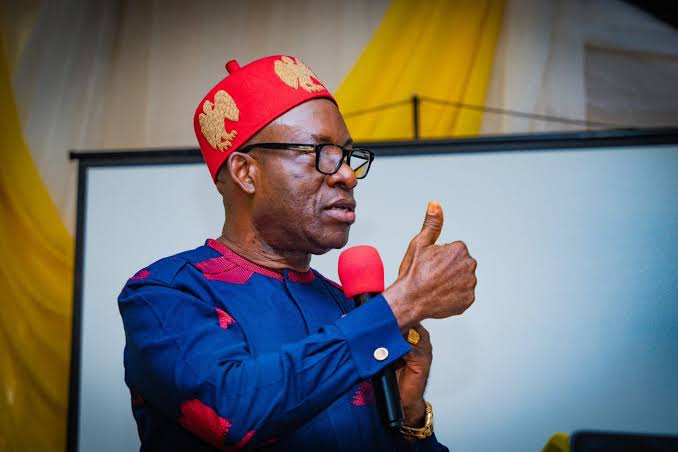
Praise across the aisle is a rare thing in politics. Political actors are more often than not so conditioned to view every policy thru partisan lenses, cheering only what their political parties initiate and discounting the achievements of others. Therefore, the recent assessment of President Bola Ahmed Tinubu’s economic reforms by the Governor of Anambra State, Professor Chukwuma Charles Soludo, a governor elected on the platform of the All Progressives Grand Alliance (APGA) deserves serious national reflection.
Governor Soludo is not from the ruling All Progressives Congress (APC). He is a member of the All Progressives Grand Alliance (APGA), a party that has always maintained its independent political identity. More importantly, he rules Anambra State in the Southeast, the geopolitical zone where President Tinubu got the least electoral support in the 2023 presidential election. If there was any region where political incentives would be in favor of criticism rather than commendation of the Federal Government, it would be certainly the Southeast.
But addressing investors and policymakers at the Delta State Economic and Investment Summit, Soludo gave an analysis that went beyond political sentiments. He said the Nigerian economy has stabilized and “turned the corner” under President Bola Ahmed Tinubu, citing stronger macroeconomic fundamentals, rising foreign exchange reserves, greater investor confidence and improved fiscal stability.
This was not the language of a partisan friend. It was the considered judgment of one of Nigeria’s most distinguished economists. That’s an important distinction.
Prof. Soludo is not merely a sitting governor. A former Governor of the Central Bank of Nigeria (CBN), he is one of Nigeria’s most respected economic technocrats, whose contributions to banking consolidation remain part of Nigeria’s modern economic history. When such a person says nice things about macroeconomic reforms, his words are naturally taken more seriously than just political rhetoric.
His intervention deserves attention not because it suggests that Nigeria’s economic journey has been completed, which it clearly has not, but because it recognizes that difficult structural reforms are beginning to yield measurable results.
When President Tinubu assumed office in May 2023, the economy faced one of its biggest challenges with mounting fiscal pressures, declining investor confidence, multiple exchange rate distortions, ballooning subsidy costs, dwindling public revenues and unsustainable debt obligations. State governments faced increasing demands for infrastructure, health care, education and security, but many were unable to meet basic commitments.
The signs were there to see. Public finances had become increasingly tight. The recurring obligations and unsustainable subsidy payments were consuming resources that should have been used for development.
The hard choices that followed were never going to be popular with the electorate. The cutting of fuel subsidies brought immediate hardship. Exchange rate reforms initially generated inflationary pressures.
Many Nigerians wondered if the pain would ever yield meaningful gains. Such huge economic reforms rarely bring immediate comfort. They are designed to correct structural distortions built up over many years. Their benefits come slowly.
There are now increasing signs that those difficult choices are starting to restore macroeconomic stability. This is exactly what Soludo acknowledged.
His mention of Nigeria’s stronger foreign exchange reserves, which are said to have increased to about $52 billion, is more than a statistical improvement. Healthy reserves build a country’s ability to withstand external shocks, reassure investors, stabilize the currency and improve confidence in the broader economy.
His observation of exchange rate predictability is equally significant. Predictable economic policies are good for business. Investors put money where uncertainty is reduced.
When foreign exchange markets become more transparent, manufacturers are better able to plan production. Better market confidence is positive for importers, exporters and financial institutions.
These developments will not immediately solve all economic challenges. But they are important building blocks. Perhaps the most significant part of Soludo’s comments is about the fiscal health of Nigeria’s states.
For many decades, many subnational governments depended largely on monthly allocations from the Federation Account Allocation Committee (FAAC) and often had to balance the need to finance infrastructure with the need to pay salaries and pensions.
This fiscal landscape has been fundamentally altered by the Federal Government’s reforms. Increased revenues to states have created more fiscal space for them. Governors in Nigeria are now better placed to deliver capital projects, improve public services and invest in critical infrastructure across Nigeria.
Read Also: Bisola Aiyeola Explains Decision to Leave Baby Daddy After Child’s Second Birthday
Roads are being built. Healthcare facilities are being increased. More investments in agriculture. Educational infrastructure is being re-evaluated.
Governance outcomes will, of course, vary from state to state, but the improved fiscal environment has certainly strengthened the fiscal position of many state governments.
I do not speak as a partisan. This is reflected in the financial realities confronting subnational governments. Interestingly, Soludo himself used Anambra as a case study of prudent fiscal management, noting that his administration has not resorted to borrowing to pay salaries or meet routine obligations.
His statement highlights an important point. Possibilities for federal reforms.
The use of those opportunities is up to the state governments and how effective they are in using them. Maintaining fiscal discipline at the subnational level remains essential.
Soludo’s professional background is another reason his endorsement has unusual credibility. Being a former CBN Governor, he knows monetary policy, exchange rate dynamics, fiscal sustainability and macroeconomic management far more deeply than the average political commentator.
President Tinubu’s reforms have built major momentum. The next phase now is translating improved fiscal stability into inclusive economic growth that touches households in every community.
Good economies are built thru difficult reforms, patient implementation and institutional consistency, history has shown. Not many countries can achieve sustainable development without facing painful structural weaknesses.
In the end, the intervention by Governor Soludo provides an important lesson for Nigeria’s political class. Partisan rivalry should never be a casualty of national development. Responsible leaders should recognize progress when objective evidence shows progress, regardless of political affiliation.